Basic information
Performing Arts Magnet
Room 312
Schedule:
| Period | Class | Grade | ||
| 1 | Conference | --- | ||
| 2 | Honors Contemporary Composition | 11 | ||
| 3 | Journalism 1B,2B,3B | 9,10,11,12 (Open to all students) | ||
| 4 | AP Research B | 11, 12 | ||
| 5 | Conference | --- | ||
| 6 | Honors Contemporary Composition | 11 | ||
| 7 | Journalism 1B,2B,3B | 9,10,11,12 (Open to all students) | ||
| 8 | Honors Contemporary Composition | 11 |
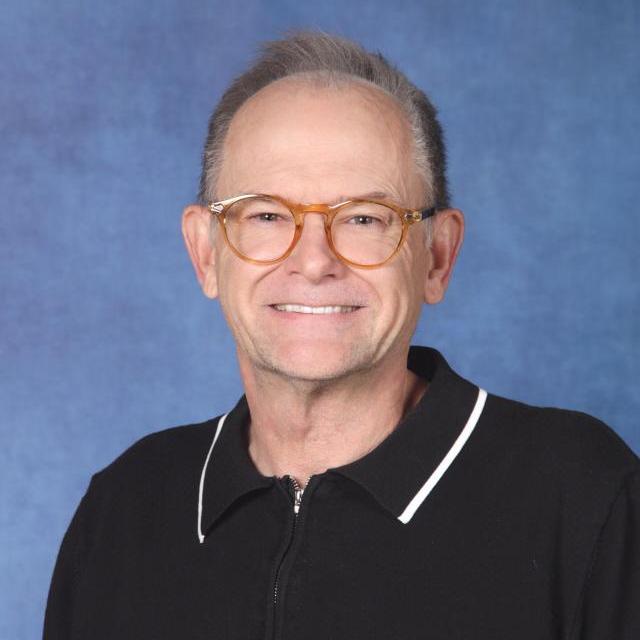
After 25 years in professional journalism, Ron Goins now chairs the English Department at Van Nuys High School and advises The Mirror, the school's student newspaper. He teaches Honors Contemporary Composition, AP Research, and journalism. Under his advising, The Mirror has earned four NSPA Pacemaker Awards, four CSPA Gold Crowns from Columbia University, and Best High School Newspaper from the LA Press Club, with ten consecutive Pacemaker nominations.
I came to teaching after a quarter century in newsrooms, and that shapes everything about how I run my classroom. I treat students as capable of doing real intellectual work, because they are. The Mirror is a working newsroom, not a class project. Editors hire and supervise their own staff. Stories go through real editing cycles, and the work goes out to a real public audience. Mistakes carry consequences and so does excellence. Students do not rise to lowered expectations.
The same principle runs through my English classes. I want students to make meaning themselves, not borrow it from me. There is a difference between a student who memorizes that The Great Gatsby is about the failure of the American dream and a student who arrives at that reading on her own, through evidence she gathered and arguments she tested. The first kind of knowledge is rented. The second is owned. I design my units so the analytical work happens in class, by hand, with evidence students collected and reasoning they can defend. This also happens to be how you produce writing that no AI tool can fake. Good pedagogy and AI-resistant assessment turn out to be the same thing.
What stays with me from the newsroom is that craft gets built through reps. A reporter does not learn to write a lead by reading about leads. She learns by writing one, getting it back marked up, writing it again, and watching it improve over years. I run my classes the same way. Students write often. They get their work back with real feedback marked on the page, not just praise or a grade. They revise, and revise again. The work improves because the student does it, not because I rescue it.
The students at this school deserve a serious program. That is what I try to give them.
The year split into two arcs in Honors Contemporary Composition. The fall covered American Literature by period from Colonial through Naturalism. Anchor texts were Anne Bradstreet's "Verses upon the Burning of Our House" for the Colonial unit, Emerson for Transcendentalism, Poe's "The Raven" for Dark Romanticism, Kate Chopin's "The Story of an Hour" for Realism, and Stephen Crane's "The Open Boat" for Naturalism. Each unit asked students to do close work with a specific analytical lens, DIDLS or SPACE or TWIST, and to end with an in-class timed essay built from evidence they had collected by hand.
The spring shifted into contemporary composition proper. The centerpiece was a nineteen-day Great Gatsby Writers' Room unit. Students worked in development teams to adapt the novel into a six-episode limited series, building Series Bibles, breaking episodes, and writing script scenes. Every creative choice had to be justified with textual evidence. I am not pretending this was a screenwriting program. The point was to make adaptation a vehicle for the same close reading we had been doing all fall, with the stakes redistributed.
From there came two literary theory units. Five days on Steinbeck's "The Chrysanthemums" through a feminist lens, focused on the difference between individual sexism and structural patriarchy. Then a shorter unit on Ginsberg's "A Supermarket in California" through queer theory, with Whitman as the primary addressee and the supermarket itself as the central image. Both units ended with timed in-class essays.
AP Research followed the College Board arc from topic to defense. Fall was inquiry proposal, IRB review, annotated bibliography, and literature review. Winter was data collection and analysis. Spring was the academic paper, the presentation and oral defense, and finally the PREP folder curation and a D-E-A-L reflection on the defense experience itself.
The Mirror covered a heavy news year. Students reported on the LAUSD superintendent investigation, the Cesar Chavez sexual abuse allegations and the resulting board vote to rename schools and the March 31 holiday, California out-migration, and a long stretch of sports and arts features. They also served as Pacemaker judges on outside publications. Grading other newsrooms against the standard you aspire to sharpens the eye in a way nothing else does.